New York Philharmonic Young People's Concerts — Season 1
About this season
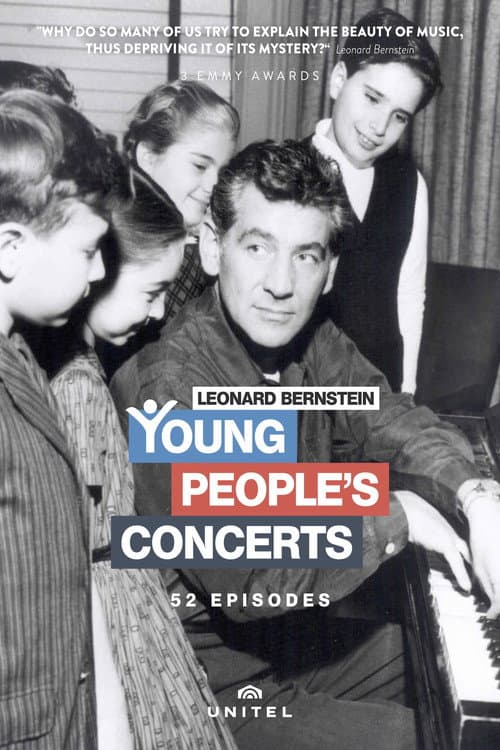
From 1958 through 1973, renowned conductor and composer Leonard Bernstein and the New York Philharmonic Orchestra thrilled audiences with wonderful concert experiences presented in a sparkling music-with-commentary format: the Young People's Concerts.
Episodes (53)
1. What Does Music Mean?
Aired 18 January 1958
Leonard Bernstein told the television audience at the start of the first Young People's Concert: "No matter what stories people tell you about what music means, forget them. Stories are not what music means. Music is never about things. Music just is. It's a lot of beautiful notes and sounds put together so well that we get pleasure out of hearing them. So when we ask, 'What does it mean; what does this piece of music mean?' we're asking a hard question. Let's do our best to answer it." During the course of this first program the New York Philharmonic performs portions of Rossini's William Tell Overture, Beethoven's Sixth Symphony, and Ravel's La Valse.
2. What is American Music?
Aired 1 February 1958
From Carnegie Hall, Bernstein discusses the origins and characteristics of American music. After an extended excerpt from George Gershwin's An American in Paris and a discussion of nationalistic and folk music, excerpts from compositions by American composers Edward MacDowell, William Schuman, Virgil Thomson, and others are performed. In closing Aaron Copland conducts parts of his own Third Symphony.
3. What is Orchestration?
Aired 8 March 1958
After brief introductory remarks, Bernstein conducts the finale of Rimsky-Korsakov's Capriccio espagnol and then explains what a composer must know in order to orchestrate music successfully. He compares the flute to the trumpet, and the clarinet to the viola, with examples from Debussy and Gershwin. After asking the audience to sing two notes in a variety of ways, he contrasts the families of instruments that compose an orchestra, using excerpts from Prokofiev, Hindemith, Mozart and others to illustrate, and ends with Ravel's Bolero.
4. What Makes Music Symphonic?
Aired 13 December 1958
Using the examples of Mozart's Jupiter Symphony and Tchaikovsky's Fourth Symphony, Bernstein demonstrates the techniques of repetition and variation int he development of symphonic music. After conducting part of Tchaikovsky's Romeo and Juliet, he asks the audience to sing "Frére Jacques," demonstrating the uses of sequence and imitation in symphonic composition. The final movement of Brahm's Second Symphony is then analyzed and played.
5. What is Classical Music?
Aired 24 January 1959
Bernstein conducts Handel's Water Music and cites it as an indisputable example of classical music. "Exact" is the word that best defines classical music, Bernstein says, and he demonstrates with musical illustrations from Bach's Fourth Brandenburg Concerto, Mozart's Concerto No. 21 in C Major and The Marriage of Figaro, and Haydn's Symphony No. 102. The decline of classical music at the end of the eighteenth century is tied to Beethoven's innovations and the Romantic movement, and Bernstein conducts Beethoven's Egmont Overture.
6. Humor in Music
Aired 28 February 1959
Using excerpts from Shostakovich, Mahler, Haydn and others Bernstein demonstrates how a "serious" composition can take an unexpected humorous turn. Prokofiev's Classical Symphony is played in its entirety.
7. What is a Concerto?
Aired 28 March 1959
Leonard Bernstein discusses the development of the concerto form from Bach to Bartok. Bernstein conducts examples of early concertos-Bach's Fifth Brandenburg Concerto and Vivaldi's Concerto in C Major. From the classical period, he conducts Mozart's Sinfonia Concertante and, finally, the fourth and fifth movements of Bartok's neo-classical Concerto for Orchestra.
8. Who is Gustav Mahler?
Aired 7 February 1960
Leonard Bernstein celebrates Mahler's centennial by conducting excerpts from the composer's Fourth Symphony in G and discussing his career as a composer and conductor. Soprano Reri Grist joins the orchestra in a performance of the last movement of the Fourth Symphony. William Lewis sings "Youth" and Helen Raab sings from "The Farewell," both from Mahler's The Song of the Earth (Das Lied von der Erde).
9. Young Performers No. 1
Aired 6 March 1960
Daniel Domb; Kenneth Schermerhorn; Barry Finclair; Stefan B. Mengelberg; Alexandra Wager
10. Unusual Instruments of Present, Past, and Future
Aired 27 March 1960
New York Pro Musica; Noah Greenberg; Vladimir Ussachevsky; Anita Darian
11. The Second Hurricane
Aired 24 April 1960
The High School of Music & Art
12. Overtures and Preludes
Aired 8 January 1961
13. Aaron Copland Birthday Party
Aired 12 February 1961
Aaron Copland; William Warfield
14. Young Performers No. 2
Aired 19 March 1961
Lynn Harrell; Elyakum Shapirra; Jung-Ja Kim; Russell Stanger; Veronica Tyler; Gregory Millar; Henry Chapin
15. Folk Music in the Concert Hall
Aired 9 April 1961
Bernstein discusses folk music and its influence on orchestral music, and conducts excerpts from Mozart, Chavez and Ives, and "Songs of the Auvergne" sung by Marni Nixon.
16. What is Impressionism?
Aired 1 December 1961
Bernstein focuses on impressionism in music, discussing the methods and styles of Debussy and Ravel. He conducts three movements from La Mer and the final dance of Daphnis et Chloe.
17. The Road to Paris
Aired 18 January 1962
Zara Nelsova
18. Happy Birthday, Igor Stravinsky
Aired 26 March 1962
Bernstein sketches a brief history of Stravinsky's musical career, noting changes of style and shifts of direction. The whole of Petrouchka is played and each scene is analyzed.
19. Young Performers No. 3
Aired 14 April 1962
Seiji Ozawa; Gary Karr; Maurice Peress; John Canarina; Ruth & Naomi Segal; Paula Robison; Paul Green; Tony Cirone; David Hopper
20. The Sound of a Hall
Aired 21 November 1962
John Corigliano, Sr.; Frank Gullino; Joseph Bernstein; William Dembinsky
21. What is a Melody?
8.0Aired 21 December 1962
Bernstein discusses the different forms melody can take, including tune, theme, motive, melodic line and musical phrase. He illustrates by conducting the orchestra in excerpts from Tchaikovsky, Wagner, Mozart, Hindemith, and Brahms.
22. Young Performers No. 4
8.0Aired 15 January 1963
Joan Weiner; Yuri Krasnopolsky; Claudia Hoca; Zoltán Rozsnyai; Pamela Paul; Serge Fournier; André Watts
23. The Latin American Spirit
8.0Aired 8 March 1963
Bernstein discusses "the two ingredients that give this music its special Latin flavor: rhythm and color." Excerpts include Bernstein's own Symphonic Dances from West Side Story.
24. A Tribute to Teachers
8.0Aired 29 November 1963
25. Young Performers No. 5
8.0Aired 23 December 1963
Heidi Lehwalder; Amos Eisenberg; Weldon Berry, Jr.; Claudio Abbado; Shulamit Ran (as Shulamith Ran); Pedro Calderon; Stephen E. Kates; Zdeněk Košler
26. The Genius of Paul Hindemith
8.0Aired 23 February 1964
27. Jazz in the Concert Hall
7.0Aired 11 March 1964
Bernstein discusses the blending of jazz and symphonic music, with performances and readings to illustrate. The program ends with Larry Austin's Improvisations for Orchestra and Jazz Soloists.
28. What is Sonata Form?
7.0Aired 6 November 1964
Bernstein describes the three-part sonata form, and exemplifies it by singing the Beatle's "And I Love Her." Veronica Tyler sings Micaela's aria from Bizet's Carmen and Bernstein conducts the Philharmonic in the first movement of Mozart's Jupiter Symphony.
29. Farewell to Nationalism
7.0Aired 30 November 1964
30. Young Performers No. 6
8.0Aired 28 January 1965
Patricia Michaelian; James Boswell IV
31. A Tribute to Sibelius
8.0Aired 19 February 1965
Bernstein celebrates the one hundredth anniversary of the birth of Finnish composer Jean Sibelius, and comments on Finland, the Finnish language, and Finnish patriotism, as well as Sibelius himself. Works by the composer, including Finlandia and the first movement of his Violin Concerto, with soloist Sergiu Luca, are performed.
32. Musical Atoms: A Study of Intervals
7.0Aired 29 November 1965
Bernstein explains musical intervals and discusses their relationship to harmony, melody and inversion. After analysis, the first movement of Symphony No. 4 in E-flat Major by Brahms is performed. The discussion continues, focusing on major and minor seconds.
33. The Sound of an Orchestra
8.0Aired 14 December 1965
Bernstein explains that the duty of the orchestra is to reproduce faithfully the notes and instructions of the composer. The main focus is the first half of Haydn's Symphony No. 88. The opening music is deliberately played incorrectly and errors are pointed out.
34. A Birthday Tribute to Shostakovich
8.0Aired 15 December 1965
Bernstein celebrates Dmitri Shostakovich's sixtieth birthday by discussing his work and conducting an excerpt from his Symphony No. 7 and all of Symphony No. 9.
35. Young Performers No. 7
8.0Aired 22 February 1966
Performers include Paul Schoenfeld; Stephanie Sebastian; David Oei; Horacio Gutiérrez; James DePreist; Jacques Houtmann; Edo de Waart.
36. What is a Mode?
9.0Aired 23 November 1966
Bernstein discusses scales, intervals and tones, and analyzes several pieces, including Debussy's Fêtes, Rimsky-Korsakov's Scheherazade, and music from the Kinks and the Beatles, to illustrate different modes. An excerpt from Bernstein's ballet Fancy Free is also performed.
37. Young Performers No. 8
8.0Aired 27 January 1967
Elmar Oliveira; Mark Salkind; Fred Alston; Donald Green; Juan Pablo Izquierdo; Sylvia Caduff; George Reid; Young Uck Kim
38. Charles Ives: American Pioneer
8.0Aired 23 February 1967
39. Alumni Reunion
8.0Aired 19 April 1967
Stephen E. Kates; Veronica Tyler; André Watts
40. A Toast to Vienna in 3/4 Time
8.0Aired 25 December 1967
Bernstein pays tribute to New York Philharmonic's "fraternal orchestra," the Vienna Philharmonic, in celebration of the 125th anniversary of both orchestras. Works by Johann and Richard Strauss, Mozart, Beethoven, and Mahler are performed, preceded by a brief discussion.
41. Forever Beethoven
8.0Aired 28 January 1968
Joseph Kalichstein; Paul Capolongo
42. Young Performers No. 9
7.0Aired 31 March 1968
Lawrence Foster; Alois Springer; Martin and Steven Vann; Helen Quach, Michael DeTemple
43. Quiz-Concert: How Musical Are You?
8.0Aired 26 May 1968
Leonard Bernstein quizzes Avery Fisher Hall and television audiences on their musicality. Highlights include true-or-false questions with musical examples, and excerpts from Mozart, Prokofiev, and Rimsky-Korsakov.
44. Fantastic Variations (Don Quixote)
8.0Aired 25 December 1968
Lorne Munroe, cellist
45. Bach Transmogrified
8.0Aired 27 April 1969
Michael Korn; Leopold Stokowski; Moog synthesizer; New York Rock and Roll Ensemble
46. Berlioz Takes a Trip
8.0Aired 25 May 1969
Bernstein discusses what he describes as the "first psychedelic symphony," Berlioz's La Symphonie fantastique, examining the concept of the idée fixe in music and illustrating this concept with excerpts froth first movement. Bernstein analyzes the music and discusses the story line of the remaining movements, which are performed by the Philharmonic.
47. Two Ballet Birds
8.0Aired 14 September 1969
Bernstein compares the main theme of Tchaikovsky's Swan Lake with Stravinsky's Firebird. A performance of the pas de deux from Swan Lake illustrates the concept of abstract ballet, followed by excerpts from Stravinsky's Firebird.
48. Fidelio: A Celebration of Life
8.0Aired 29 March 1970
Bernstein takes a look at Beethoven's so-called "flawed masterpiece" - his only opera, Fidelio. After discussing the story and its problems, "charming excerpts" are performed. Four vocal selection from Act II follow, each preceded by analysis and plot summary.
49. The Anatomy of a Symphony Orchestra
7.0Aired 24 May 1970
50. A Copland Celebration
8.0Aired 27 December 1970
51. Thus Spake Richard Strauss
8.0Aired 4 April 1971
52. Liszt and the Devil
8.0Aired 13 February 1972
53. Holst: The Planets
8.0Aired 26 March 1972